Which Countries Use AI the Most? Ranked by Adoption Rate (2026)
Which Countries Use AI the Most? Ranked by Adoption Rate (2026)
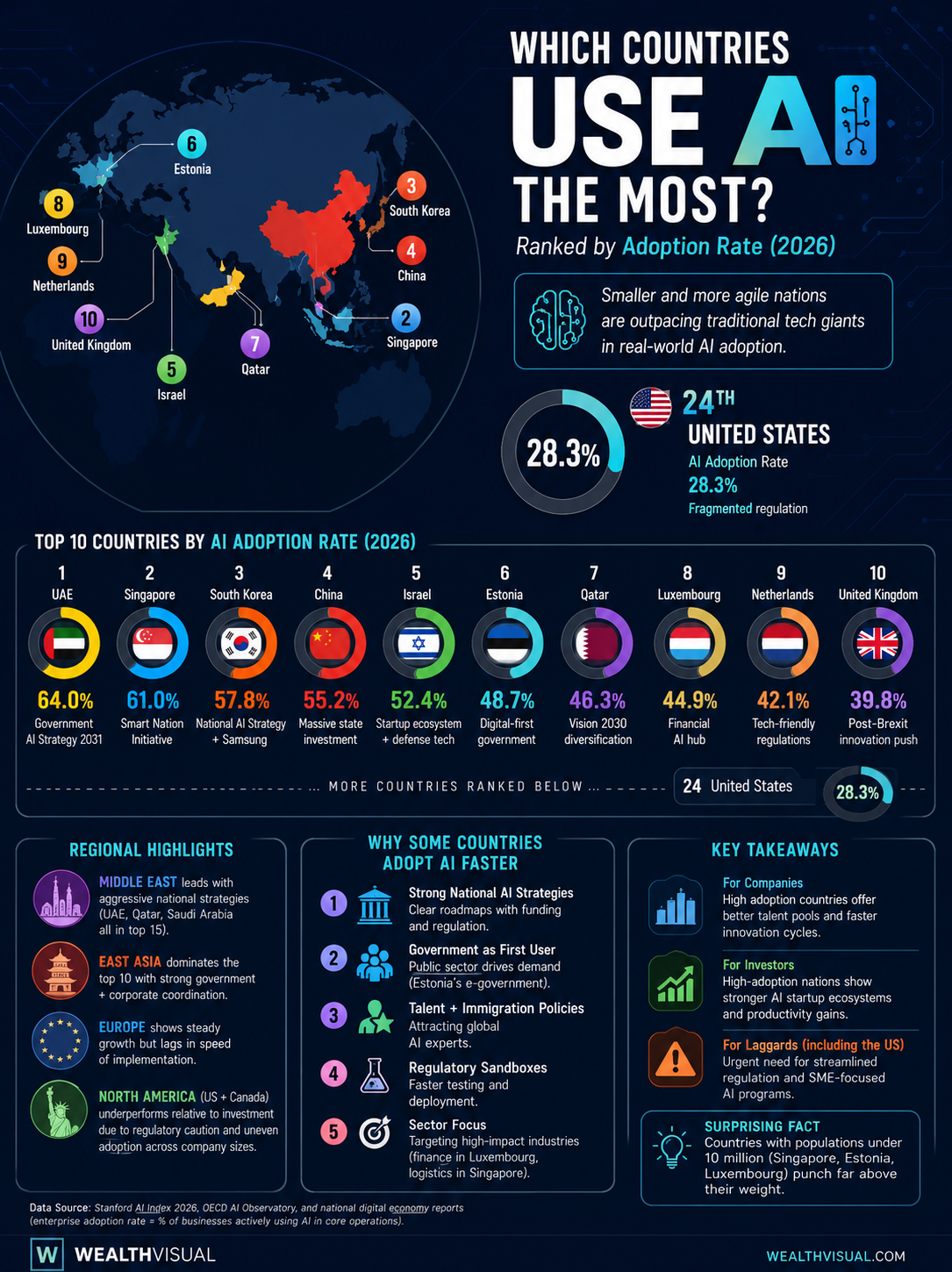
The United States is no longer the undisputed AI leader. In 2026, smaller and more agile nations are outpacing traditional tech giants in real-world AI adoption.
New global data reveals surprising leaders: Singapore (61%) and the UAE (64%) top the charts, while the US ranks only 24th with just 28.3% enterprise adoption. This ranking is based on actual business implementation rates across industries, not just research papers or investment.
Top 20 Countries by AI Adoption Rate (2026)
| Rank | Country | AI Adoption Rate (%) | Key Driver |
|---|---|---|---|
| 1 | UAE | 64.0 | Government AI Strategy 2031 |
| 2 | Singapore | 61.0 | Smart Nation Initiative |
| 3 | South Korea | 57.8 | National AI Strategy + Samsung |
| 4 | China | 55.2 | Massive state investment |
| 5 | Israel | 52.4 | Startup ecosystem + defense tech |
| 6 | Estonia | 48.7 | Digital-first government |
| 7 | Qatar | 46.3 | Vision 2030 diversification |
| 8 | Luxembourg | 44.9 | Financial AI hub |
| 9 | Netherlands | 42.1 | Tech-friendly regulations |
| 10 | United Kingdom | 39.8 | Post-Brexit innovation push |
| ... | ... | ... | ... |
| 24 | United States | 28.3 | Fragmented regulation |
Data Source: Stanford AI Index 2026, OECD AI Observatory, and national digital economy reports (enterprise adoption rate = % of businesses actively using AI in core operations).
Regional Highlights
- Middle East leads with aggressive national strategies (UAE, Qatar, Saudi Arabia all in top 15).
- East Asia dominates the top 10 with strong government + corporate coordination.
- Europe shows steady growth but lags in speed of implementation.
- North America (US + Canada) underperforms relative to investment due to regulatory caution and uneven adoption across company sizes.
Surprising Fact: Countries with populations under 10 million (Singapore, Estonia, Luxembourg) punch far above their weight.
Why Some Countries Adopt AI Faster
- Strong National AI Strategies — Clear government roadmaps with funding and regulation (UAE, Singapore).
- Government as First User — Public sector drives demand (Estonia’s e-government).
- Talent + Immigration Policies — Attracting global AI experts (Israel, Singapore).
- Regulatory Sandboxes — Faster testing and deployment.
- Sector Focus — Targeting high-impact industries (finance in Luxembourg, logistics in Singapore).
Implications for Businesses and Policymakers
- For Companies: Countries with high adoption rates offer better talent pools and faster innovation cycles.
- For Investors: High-adoption nations show stronger AI startup ecosystems and productivity gains.
- For Laggards (including the US): Urgent need for streamlined regulation and SME-focused AI programs.
⚠️ Disclaimer
This article is for informational and educational purposes only and should not be construed as financial advice or a recommendation to buy or sell any security. WealthVisuals does not provide personalized investment, tax, or legal advice. Always consult with qualified professionals before making financial decisions. Past performance does not guarantee future results.
Related Articles
15 AI Side Hustles That Actually Work (With Real Income Potential)
Discover 15 proven AI side hustles that actually make money in 2026. Learn real income potential, tools, and strategies to start today
The Rise of Voice Commerce: How Voice AI Is Changing Retail in 2026
Explore how voice AI and voice commerce are transforming retail in 2026. This guide covers current trends, top platforms, opportunities for brands, challenges, and strategies to succeed in the voice-first shopping era.
The Complete Guide to Making Money with AI in 2026 (Beginner to Advanced)
Learn how to make money with AI in 2026 using proven methods like AI side hustles, automation, investing, and scalable online businesses. Beginner-friendly guide.